|
Majority of visible light coming to us from space originated in
stars, which shine because their surfaces are hot; some glow red or
orange like a hot iron, some yellow or nearly white like a filament in
a classical light bulb, and others shine blue. Due to different
temperatures of stars their prevailing color varies, but, in general,
starlight covers the whole visible spectrum. When astronomers capture
objects composed mainly by stars (galaxies, star clusters, …), they
use RGB filters to capture all the colors and later create a so-called
true-color image.
Still, not all objects shine because they are hot. For example, the
light from nebulae originates in electron shells of their atoms. Such
light, emitted by electrons going from one quantum state to another,
has only a very specific energy and thus also the wavelength (color).
Astronomers use this fact by employing narrow-band filters to exclude
everything but a small part of the incoming light and thus can greatly
increase signal-to-noise ratio (we get all signal we care about, but
background noise is strongly suppressed). Since both the Hα and SII filters land in seemingly similar very
dark-hued reds, astronomers often assign false colors to the
narrow-band channels.
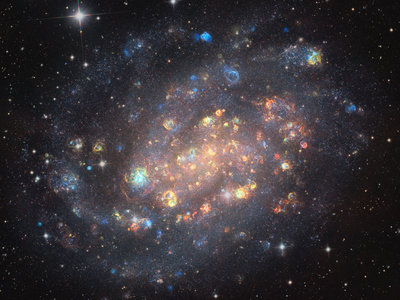
The NGC300, captured by CielAustral team, is a galaxy and as such shines
mainly in continuous spectrum. But every galaxy contains also many
nebulae emitting much narrower spectrum. So, the CielAustral team used
both RGB and narrow-band filter sets to acquire enormous 132 hours of
total exposure time. The result is a stunning image of the NGC300
galaxy with stars in real colors and, at the same time, with highly
enhanced nebulae, belonging to the NGC300, shown here in false colors
associated with OIII, Hα, and SII spectral
lines.
| 