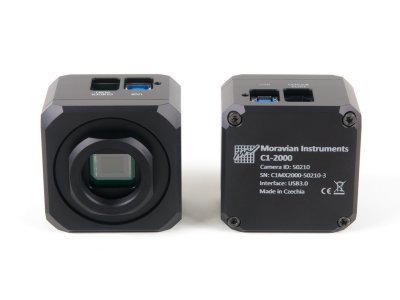
C1-2000 camera with the IMX430 sensor The physical dimensions of the sensors in the new C1-0500 and C1-2000
cameras are even slightly larger than those of the sensor in the C1-3000
cameras. The sensor size is therefore suitable for use with a separate
guide telescope as well as with off-axis guider adapters, which generally
cannot illuminate the full sensor area in cameras with very large sensors
because of the limited size of the pick-off mirror.
| Model |
CMOS sensor |
Resolution |
Pixel size |
Sensor size |
| C0/CG/C1-1500 |
IMX273 |
1456 × 1088 pixels |
3.45 × 3.45 μm |
5.02 × 3.75 mm |
| C0/CG/C1-3000(A) |
IMX252 (IMX265) |
2064 × 1544 pixels |
3.45 × 3.45 μm |
7.12 × 5.33 mm |
| C0/CG/C1-0500 |
IMX433 |
816 × 624 pixels |
9.0 × 9.0 μm |
7.34 × 5.62 mm |
| C0/CG/C1-2000 |
IMX430 |
1632 × 1248 pixels |
4.5 × 4.5 μm |
7.34 × 5.62 mm |
| C0/CG/C1-5000(A) |
IMX250 (IMX264) |
2464 × 2056 pixels |
3.45 × 3.45 μm |
8.50 × 7.09 mm |
Comparison of sensor sizes in C0, C1 and CG cameras Both camera models use the high-speed USB3.0 interface, which also
supplies power, eliminating the need for a separate power supply.
Specifically, the C1 models (unlike the C0 and CG series) feature a small
fan that significantly reduces the sensor temperature, as well as
standard M3 and 0.25 inch
threads (the thread used on photographic tripods), allowing the camera
to be mounted independently.
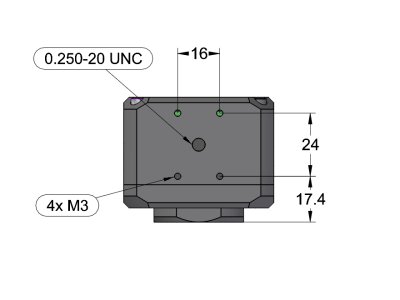
Positions of the four M3 threaded holes on the underside of the
C1 camera head All C0, C1 and CG models are equipped with a standard 6-pin
“autoguider” connector that allows direct control of telescope
mounts.
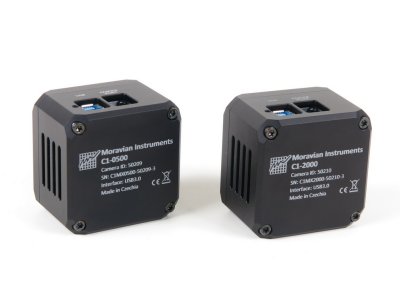
The “autoguider” connector is located next to the USB3
connector on the side of the camera 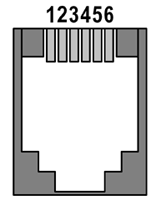 |
| 1 |
R.A. + (Right) |
| 2 |
Dec + (Up) |
| 3 |
Dec – (Down) |
| 4 |
R.A. – (Left) |
| 5 |
Common (Ground) |
| 6 |
Not connected |
|
More details are available on the C0 and C1 camera product page.
| 